

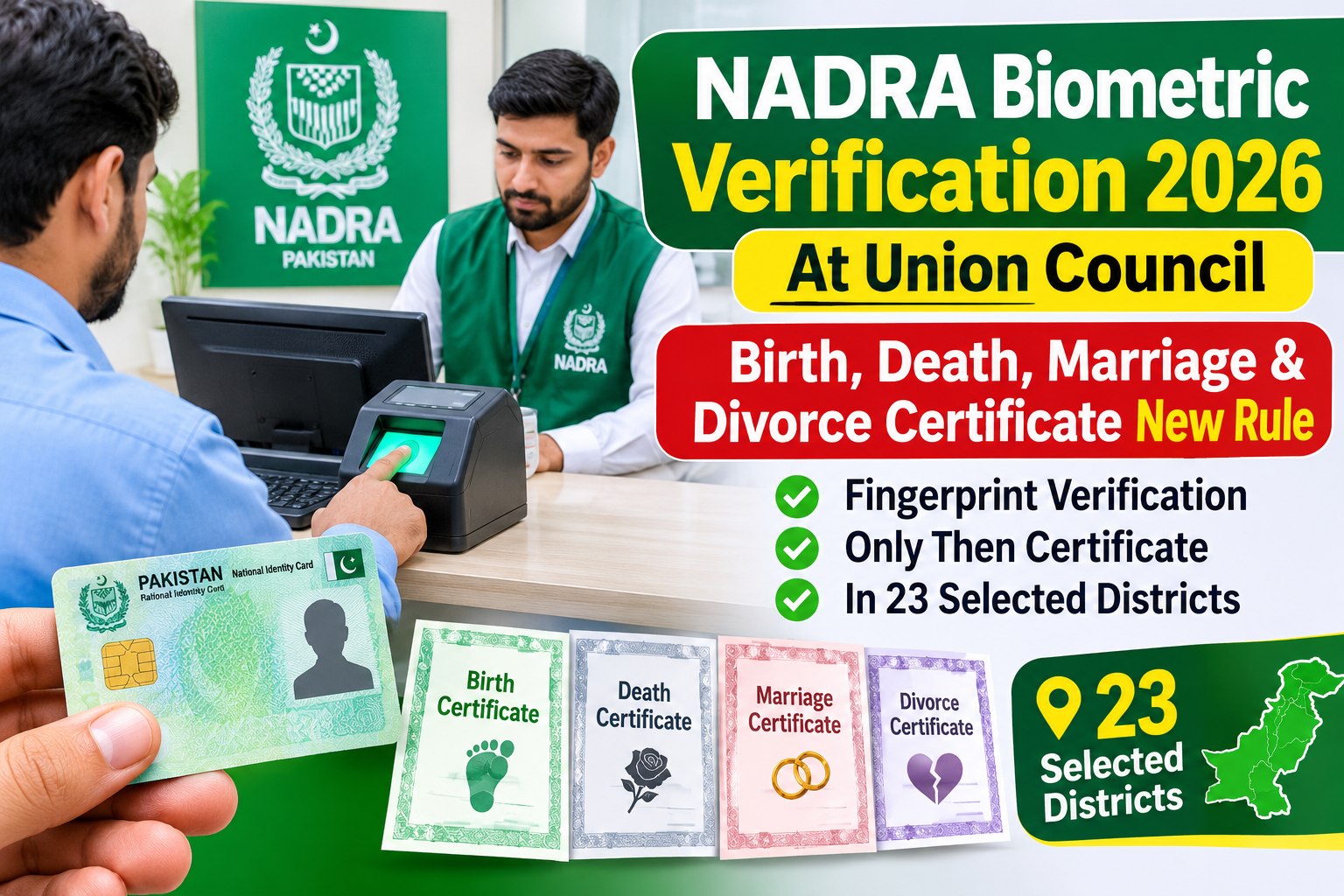
NADRA Biometric Verification 2026 at Union Council – New Rules for Birth, Death, Marriage & Divorce Certificates
Pakistan’s civil registration system is moving towards a more secure and transparent digital system in 2026. The National Database and Registration Authority (NADRA) has introduced biometric verification at Union Councils in 23 selected districts across the country. Under this new arrangement, citizens applying for birth, death, marriage, or divorce certificates must complete fingerprint verification before their documents can be issued.
This initiative aims to prevent fake registrations, eliminate fraudulent certificates, and ensure that every civil registration record is connected to a verified identity. It is particularly important because Union Council certificates are frequently used for official purposes, including CNIC applications, B-Forms, family registration records, inheritance matters, passport applications, and immigration procedures.
The new biometric verification system initially covers selected districts in Punjab, Sindh, Khyber Pakhtunkhwa, and Balochistan. Sindh has the largest share, with 12 districts included in the initial implementation.
Alongside this development, NADRA has also introduced convenient biometric verification facilities for pensioners. Eligible pensioners can now complete their Proof of Life Certificate (POLC) through the Pak-ID mobile application without visiting a bank. The certificate is free of charge and remains valid for six months.
In this detailed guide, we explain the NADRA biometric verification rules for 2026, provide the complete list of 23 districts, discuss the application procedure, explain how to download and use the Pak-ID app, and cover pensioner verification, fees, tracking IDs, and other important questions.
NADRA Biometric Verification 2026 – Latest Update
The new NADRA biometric verification arrangement requires applicants to verify their fingerprints before receiving certain civil registration certificates from their local Union Councils.
Previously, many civil registration applications relied primarily on paper documents, signatures, and supporting information. Although these procedures served an important administrative purpose, weaknesses in manual verification could sometimes allow incorrect or fraudulent registrations.
The new system introduces an additional identity verification step. Applicants must provide their fingerprints, which are checked against NADRA’s identity database.
Once the verification is successful, the relevant Union Council can continue processing the certificate application.
Important Details About the New NADRA System
| Category | Details |
|---|---|
| New facility | Biometric verification at Union Councils |
| Implementation | 23 selected districts |
| Provinces covered | Punjab, Sindh, KP, and Balochistan |
| Certificates covered | Birth, death, marriage, and divorce |
| Verification method | Fingerprint biometric verification |
| Verification location | Relevant Union Council |
| Main objective | Prevent fake and fraudulent certificates |
| Pensioner facility | Digital Proof of Life Certificate |
| Pensioner verification | Pak-ID app and designated service points |
| NADRA helpline | 1777 |
| Official website | nadra.gov.pk |
The most important thing applicants should understand is that the Union Council biometric verification process and the pensioners’ online Proof of Life facility are two different services. Both involve NADRA verification, but their procedures and purposes are not the same.
Why Has NADRA Introduced Biometric Verification at Union Councils?
Civil registration is one of the most important responsibilities of local government institutions in Pakistan. Union Councils maintain essential records relating to births, deaths, marriages, and divorces.
These records provide the foundation for many other government and legal services. A birth certificate, for example, may be needed when applying for a child’s B-Form. Similarly, marriage and divorce certificates can be required for family registration, legal documentation, inheritance matters, and immigration applications.
If incorrect information enters the civil registration system, it can create serious difficulties for citizens and government departments.
NADRA’s biometric verification initiative is designed to strengthen the reliability of these records.
1. Preventing Fake Birth and Death Certificates
Fake birth and death certificates can create problems in government records, family registration, property matters, and legal proceedings.
Fingerprint verification provides an additional identity check before a certificate is issued. It helps establish a stronger connection between the applicant and the registration process.
This can reduce opportunities for fraudulent applications and unauthorized registrations.
2. Making Marriage Registration More Secure
Marriage certificates are important legal documents used for family registration, identity-related applications, immigration, and other official purposes.
By introducing biometric verification, NADRA aims to improve the authentication process associated with marriage registration.
The objective is to make it more difficult for someone to use another person’s identity to support a fraudulent application.
3. Improving Divorce Registration Records
Divorce registration also requires accurate documentation because it affects a person’s legal and family status.
Incorrect or fraudulent divorce records can create complications in official databases and legal matters.
Biometric verification introduces an additional identity-checking measure that can help improve the reliability of the registration process.
4. Connecting Civil Records With Verified Identities
One of the main advantages of biometric verification is the connection between civil registration applications and NADRA’s identity database.
Instead of relying exclusively on paper documents, the system uses fingerprint verification to help confirm the identity of the applicant.
This supports the broader objective of creating accurate and trustworthy government records.
5. Reducing Fraud and Administrative Problems
Manual verification procedures can be vulnerable to mistakes, incomplete documentation, and identity-related fraud.
Biometric verification provides an additional layer of protection. It can also help government departments identify inconsistencies and improve the overall quality of civil registration information.
The initiative is therefore an important step towards modernizing Pakistan’s public registration services.
Complete List of 23 Districts Where NADRA Biometric Verification Has Started
The initial implementation of NADRA biometric verification covers 23 selected districts in four provinces.
Citizens should carefully check the district list before visiting their local Union Council. The new requirement applies to the selected implementation areas, while the previous procedure continues in districts that have not yet been included.
Punjab – 4 Districts
The following four districts of Punjab are included in the initial biometric verification system:
- Rawalpindi
- Jhang
- Bahawalnagar
- Sheikhupura
Residents of these districts applying for birth, death, marriage, or divorce certificates should contact their relevant Union Council to confirm the biometric verification requirements.
Punjab has four districts in the initial rollout.
Sindh – 12 Districts
Sindh has the largest number of districts included in the new NADRA biometric verification arrangement.
The 12 selected districts are:
- Karachi East
- Karachi West
- Hyderabad
- Tando Allahyar
- Sukkur
- Ghotki
- Larkana
- Qambar Shahdadkot
- Shaheed Benazirabad
- Naushahro Feroze
- Mirpurkhas
- Tharparkar
Residents of these districts should prepare for fingerprint verification when applying for the covered civil registration certificates.
Because Sindh has the largest share of selected districts, the initiative will affect a significant number of applicants across the province.
Khyber Pakhtunkhwa – 1 District
Only one district from Khyber Pakhtunkhwa is included in the initial list:
- Peshawar